







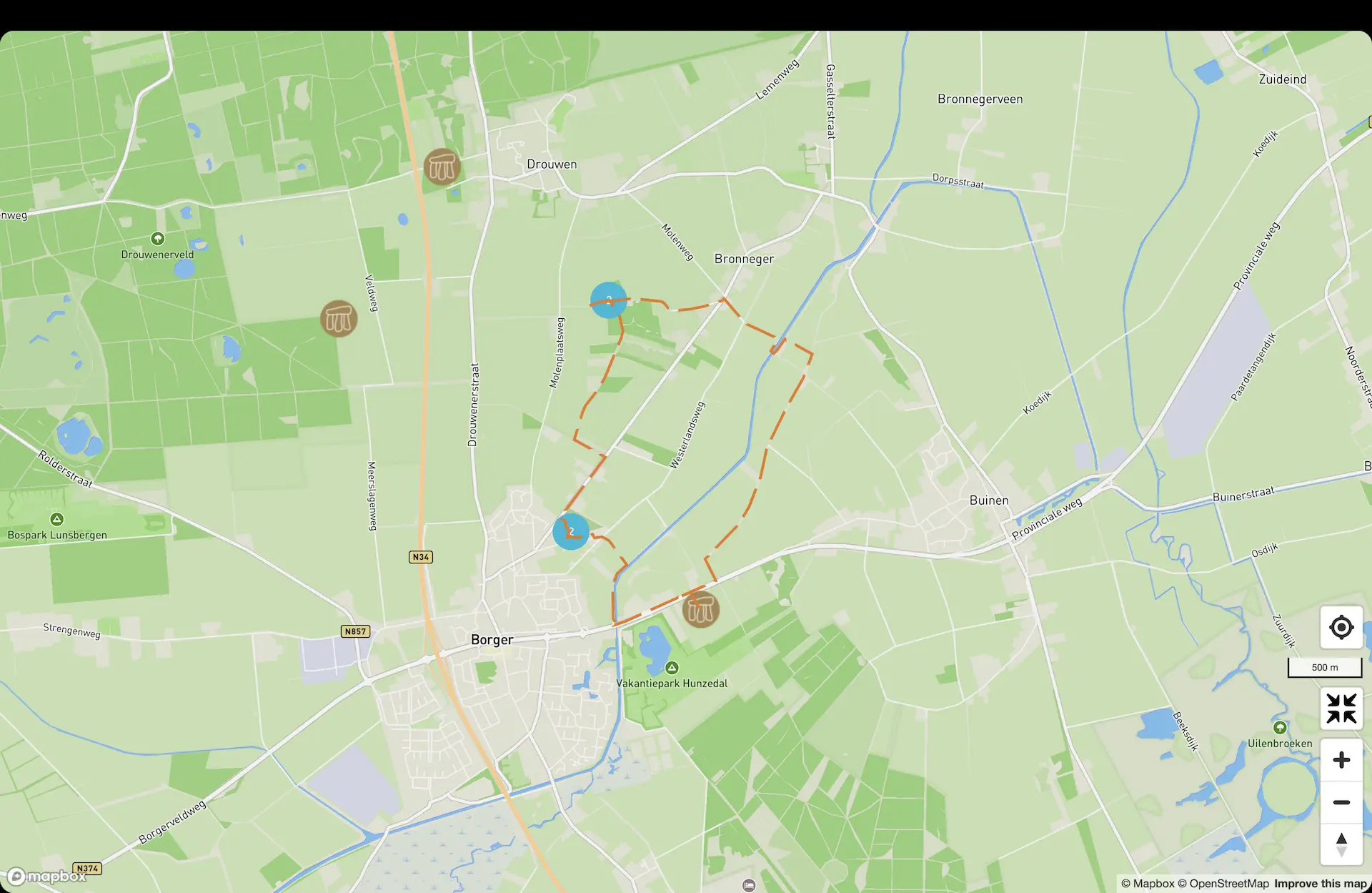
Walking is perhaps the simplest way to reconnect with yourself. No equipment needed, no registration required – just a pair of good shoes and the desire to get out and about. It instantly takes you out of the routine of everyday life. That’s why you’ll find routes on the Gofinestera map. These are mostly walking routes, with the occasional driving route, and perhaps cycling routes in the future too.
Every route takes you past something special. Sometimes it’s mainly nature, other times a single place of power, and often a whole series of them. Some routes follow centuries-old pilgrimage trails, past chapels, churches and cathedrals. Whatever the route, the aim remains the same: to bring you closer to nature, and closer to yourself.
The tours you’ll find at Gofinestera
Broadly speaking, there are three types of tour. Day trips and day walks are designed so you can set off without much preparation, often a circular walk past one or more places of power. Multi-day walks go further; these are long-distance walks that usually take the form of a pilgrimage, often featuring special places such as chapels and cathedrals along the way. Finally, car and cycle routes are primarily designed to travel from one place of power to another, for those who prefer to drive or wish to cover greater distances.
Each type of trip requires its own specific preparation. We’ll go into more detail on this later in this guide.
For each route, you’ll find the distance, the elevation changes and the type of terrain. This allows you to assess in advance whether a route suits your fitness level, even if you prefer to keep a more leisurely pace or are setting off with a pushchair.
Why walking is good for you
The health benefits of walking have been well researched. The Dutch Health Council recommends that adults engage in at least 150 minutes of moderate-intensity exercise per week – such as walking – spread over several days. Those who exercise for longer, more frequently or at a higher intensity reap even greater health benefits. Regular walking is linked to a lower risk of cardiovascular disease, better blood pressure and a stronger immune system.
Walking also has a special effect on the mind. Researchers at Stanford University discovered that people come up with more creative ideas whilst walking than whilst sitting, regardless of whether they were walking indoors or outdoors. The effect even persisted for a short while after the participants had sat down again. One possible explanation lies in the rhythm itself. The repetitive, predictable motion of walking puts you into a kind of cadence, in which thoughts flow more freely and the mind gradually clears.
Nature as medicine: the example of Scotland
On the Scottish Shetland Islands, GPs have been able to prescribe nature, alongside or instead of medication, since 2018. The initiative, set up by NHS Shetland in collaboration with RSPB Scotland, provides doctors with a calendar of seasonal suggestions to pass on to patients, ranging from feeding garden birds to a walk on the beach.
The approach proved so successful that three-quarters of participating patients reported benefiting from it, and nine out of ten healthcare professionals involved indicated they wished to continue with the approach. Nature-based prescriptions are now also being used in Edinburgh, the Orkney Islands and Argyll and Bute. The underlying idea is simple. Time spent in nature has been shown to lower blood pressure and stress hormone levels, and to improve mood and concentration. This is precisely what Gofinestera focuses on, though not on a doctor’s prescription, but on one’s own initiative.
Pilgrimage: an age-old tradition
For centuries, people have been walking to special places for a variety of reasons. Some did so out of religious conviction, to fulfil a vow or to do penance. Others simply walked to find themselves, far from home, in a completely different environment for a while.
The pilgrimage route to Santiago de Compostela in Spain is the best-known example of this. As early as the ninth century, pilgrims travelled to the tomb of the Apostle James, and in the late Middle Ages the journey was regarded as one of the three great pilgrimages of Christianity, alongside Rome and Jerusalem. After centuries of decline, interest began to grow again from the 1980s onwards. The Spanish section of the route has been on the UNESCO World Heritage List since 1993, and the French routes leading to it have been included since 1998.
Traditionally, pilgrims were offered shelter and care along the way, and they carried a scallop shell as a sign of their journey – a symbol of the many paths that converge in Santiago. Those who complete the journey still receive a certificate in Santiago, known as the Compostela. For many modern-day walkers, that certificate matters less than the journey itself. The physical challenge, the tranquillity and the time for reflection prove, for many, to be at least as valuable as the religious significance once was.
Preparing, whichever route you choose
The same applies to every journey: prepare thoroughly at home. Make sure you have a map, a fully charged mobile phone, suitable kit and, for multi-day walks, somewhere to stay overnight. Take a notebook with you if you want to write along the way, and above all, make sure you leave room for wonder.
Think in advance about what you want from this walk and with what intention you’re setting off. Are you simply going for a walk, or are you making it a proper Gofinestera walk, with time for meditation along the way? Both are possible, as long as you’re clear about it for yourself.
Also consider whether you’re going alone or with someone else. Both can result in a wonderful journey, but require a slightly different intention. Walking alone gives you more space for silence and for yourself. Walking together adds a shared experience, and often the conversation that naturally arises from the rhythm of walking.
Especially on a longer or solo walk, make sure to let someone at home know which route you’re taking and when you expect to arrive. It’s a small gesture, but it brings peace of mind, both for yourself and for those waiting for you.
Dress for the weather and wear comfortable, well-worn shoes. Rain doesn’t have to be a spoilsport. Just look how beautifully rain-soaked leaves glisten, and how fresh the air smells after a shower. Rain is part of the experience too, and is beautiful in its own way.
Take plenty of food and drink with you. Don’t underestimate yourself, but above all, don’t overestimate yourself either. Assess the difficulty of the walk carefully in advance and tailor it to your own fitness level. Check yourself for ticks in the evening after your walk, especially after a walk through woods, dunes or tall grass. The National Institute for Public Health and the Environment advises you to look particularly carefully in your groin, armpits and behind your ears – areas that can sometimes be difficult to see yourself.
Along the way: meditate in your own way
There’s no set formula for how to experience a Gofinestera walk energetically. However, you can start the day with a grounding exercise and tune into your intention for the day. If you come across a power spot along the way – one listed on the website with an accompanying exercise – go ahead and do it, but above all, do it in your own way and at your own pace.
Above all, follow your intuition. If you feel like leaning against a tree, or having a warm drink from a flask, just go ahead and do it. If you’re drawn to a particular spot, follow that pull. Gaze at the scenery, feel the wind, take in the scents and simply enjoy the moment. Do you want to close your eyes for a quick nap, or perhaps for a moment of meditation? Wonderful – by all means, do so. Feel and follow the movement, the rhythm, the freedom, and the realisation that this journey is yours and that you are treating yourself to something wonderful.
You can always do the exercises you come across along the way in written form or listen to them as audio, whichever suits you best at that moment.
Along the way, you’ll sometimes pass places that are still in full use – a church during a service, a chapel where someone has just lit a candle. In such cases, be a guest. Walk in quietly, leave the place as you found it, and leave any animals and nesting birds you come across in peace.
When things go wrong
Sometimes a hike doesn’t go to plan. You get blisters, the weather lets you down, or you’re simply tired. That’s all part of it, and you’ll always get through it. A difficult moment along the way says nothing about the hike as a whole, and… Sometimes that’s precisely the moment when you learn the most.
Day trips: delving deeper
A day trip requires less preparation than a multi-day trek, and that often gives you the space to go a little deeper energetically. Where possible, we provide tips for each trip on what you can do and where. You can also do one of the exercises from the ‘media hub’ whilst sitting on a bench. Feel free to browse through them. You’ll find an extensive library of exercises covering a wide range of topics: grounding, trust, being, surrender, letting go, and letting go of thought. There are around 50 exercises. And perhaps you won’t need them at all – maybe you have your own way of doing things.
Always bring the walk to a conscious close. Recall the walk and the places you’ve been, and feel what it has brought you. Take that feeling in carefully, so that you can carry it with you into your daily life.
Multi-day walks: freedom in walking
On a multi-day trek, you probably won’t practise meditation with the same intensity every day, and that’s perfectly fine. The walking will do its job anyway. Do, however, take regular moments to ‘go within’. And check the media hub now and then to see what suits you at that moment. Start each day with a moment of stillness and grounding, and otherwise, above all, let the freedom of walking do its work.
As you walk, regularly check in with how you’re feeling, without dwelling on it. Above all, enjoy yourself. And if you encounter difficulties along the way, see if you recognise them from your everyday life. The path itself often acts as a mirror for what’s going on elsewhere in your life.