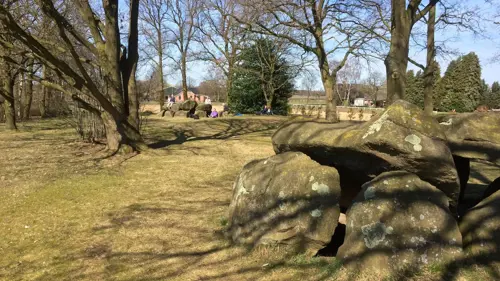












The dolmens D19 and D20 lie adjacent to each other on a gentle elevation just outside Drouwen. Their massive, weathered stones are arranged to form elongated burial mounds that dominate the surrounding landscape. D19 is the larger of the two, measuring about 15.5 meters long and 3.5 meters wide. Originally, it featured 18 vertical support stones and 9 large capstones, five of which remain visible today. D20 is smaller, retaining five of its original six capstones; these were restored and secured in 1998. Both sites are set within grassy fields and are easily accessible, presenting a striking juxtaposition of prehistoric construction and the calm rural environment of Drenthe. While many dolmens are dispersed across this region, D19 and D20 are especially noteworthy for their considerable size and the relative completeness of their surviving features.
Archaeological and Historical Findings
These dolmens were built during the Neolithic period, roughly between 3400 and 3000 BCE, by communities associated with the Funnel Beaker Culture. In 1912, archaeologist J.H. Holwerda conducted the first significant scientific excavation of Dutch dolmens at D19 and D20. This excavation revealed a remarkable collection of artifacts including fragments from approximately 400 pottery vessels, 13 flint axes, 9 amber beads, and notably, six strips of copper, which rank among the earliest metal finds in the Netherlands. Many of these items are preserved in the National Museum of Antiquities in Leiden, with some also housed in the British Museum. The tombs were constructed using large glacial stones transported to the area during the Ice Age, arranged into chambers covered by earth and stone mounds, and were originally encircled by rings of stones, though an intact stone ring around D19 has not been conclusively documented. Restoration efforts took place in 1962 and 1998 to preserve and stabilize D19.
Archaeoastronomic orientation
Measurements show that the main passage of D19 is aligned at approximately 63° 30′. However, there is no strong evidence or consensus among scholars indicating that D19 or D20 were intentionally aligned with astronomical events such as solstices or equinoxes.
Accessibility and Visitor Information
The sites of D19 and D20 are accessible via a short, clearly marked path originating from a nearby parking area or roadside. The monuments are located about 200 meters from the entrance point, along a flat, grassy trail suitable for most visitors. The terrain is mostly even and firm, with no significant slopes or steps, allowing easy access even for those with limited mobility. No ticket required.