







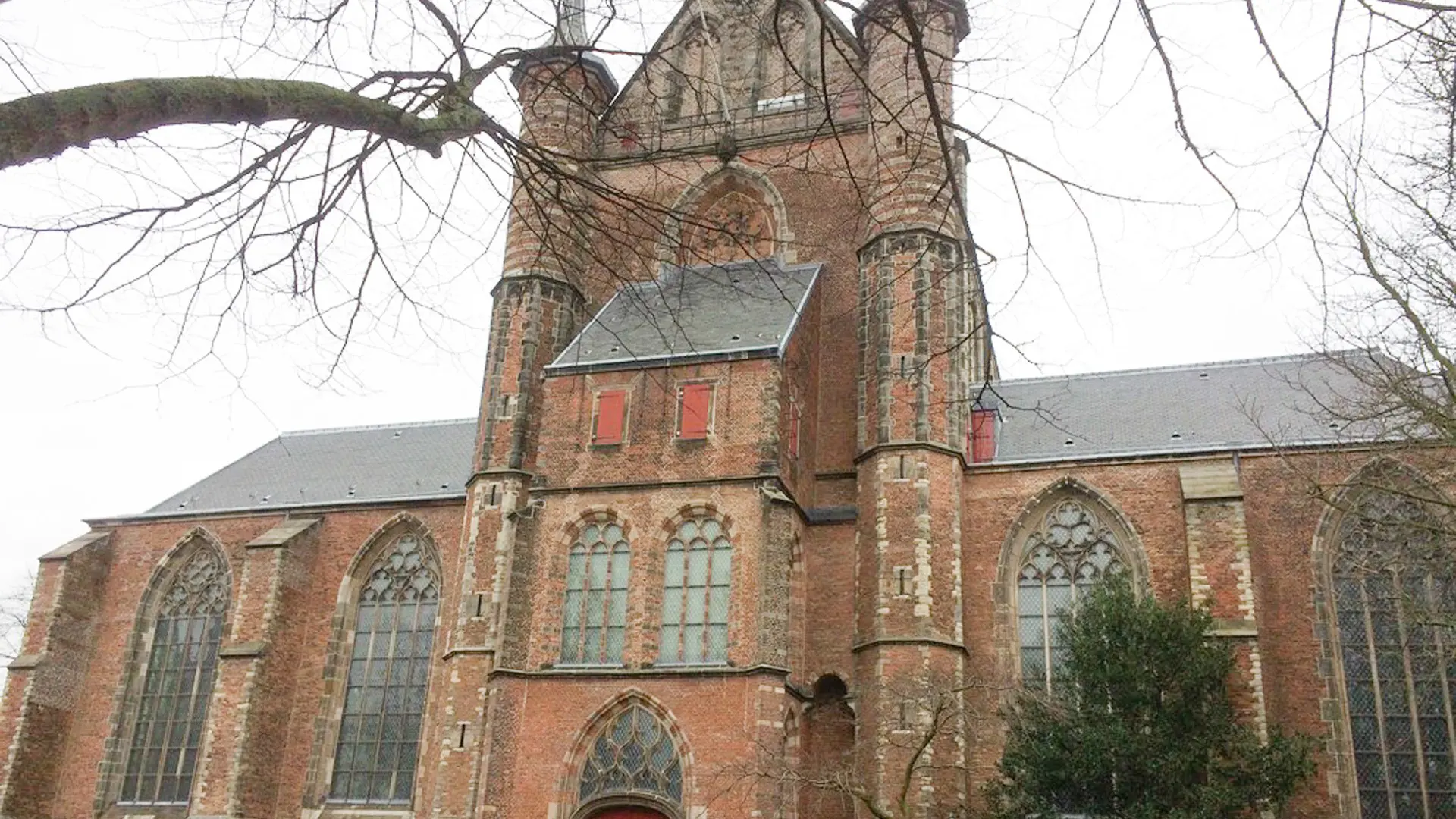





Known also as St. Peter’s Church, Pieterskerk is among the oldest buildings in Utrecht, with construction beginning in 1039 and the church officially consecrated on 1 May 1048 by Bishop Bernold. It is located on the eastern side of Utrecht’s historic district. The church was built in a solid German-Romanesque architectural style, notable for its large, single-piece red sandstone columns that support the nave, a minimalist interior design, and a crypt beneath the choir area. Originally serving as a collegiate church for Catholic canons, Pieterskerk was part of Utrecht’s historic “Kerkenkruis” (Church Cross), a grouping of five main churches in the city. Today, it serves as the place of worship for the Walloon Protestant congregation, surrounded by a small medicinal herb garden and complemented by a modest exhibition space and a second-hand bookshop.
Archaeological and Historical Findings
Studies of archaeological remains and historic documents indicate that Pieterskerk’s oldest parts, including the nave and crypt, stem from its original Romanesque construction phase. The heavy pillars are each carved from a single block of red sandstone, which is uncommon in the Netherlands. Over time, the church’s exterior evolved; for instance, the western towers were likely completed around a century after the church’s initial opening. The crypt houses the stone sarcophagus of Bishop Bernold, although his remains are no longer interred there. Pieterskerk survived the turbulent religious changes of the 16th century; after suffering threats of demolition during the 1580 Iconoclastic Fury, it was preserved partly due to families’ burial rights in its crypts. Subsequently, it served various purposes including as military barracks. Notably, the chancel was repurposed as an operating theatre for the university. Despite several alterations, the church retains key Romanesque features such as ten original pink-red sandstone columns and the atmospheric crypt beneath the choir.
Accessibility and Visitor Information
Pieterskerk is accessible via Pieterskerkhof square, which lies at the end of a quiet street in Utrecht’s old town. The route from the street to the main entrance is paved and flat, spanning roughly 30 to 40 metres, making access straightforward. Inside, the nave is spacious and mostly flat, although reaching the crypt involves navigating steps, which may limit access for some visitors. There is no admission fee.