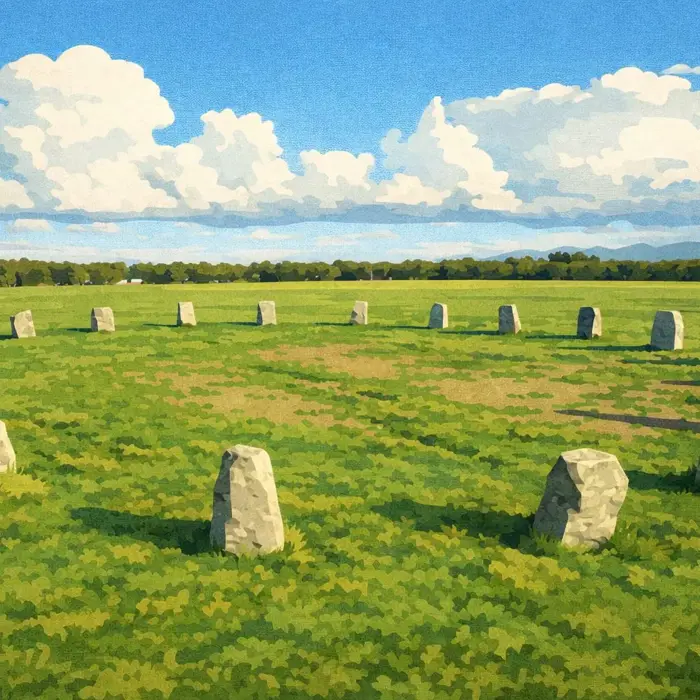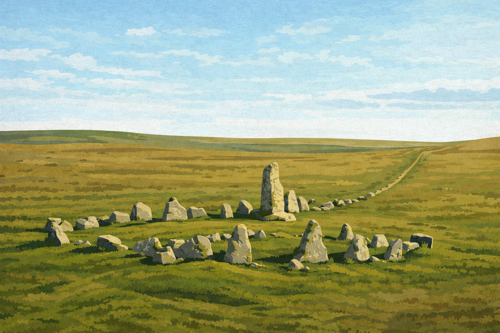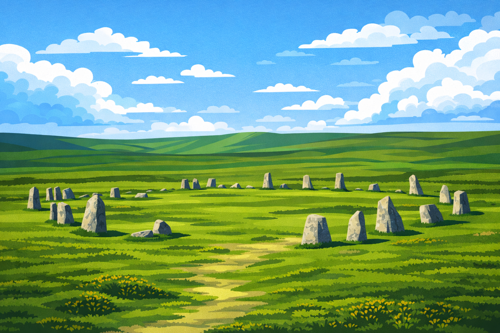




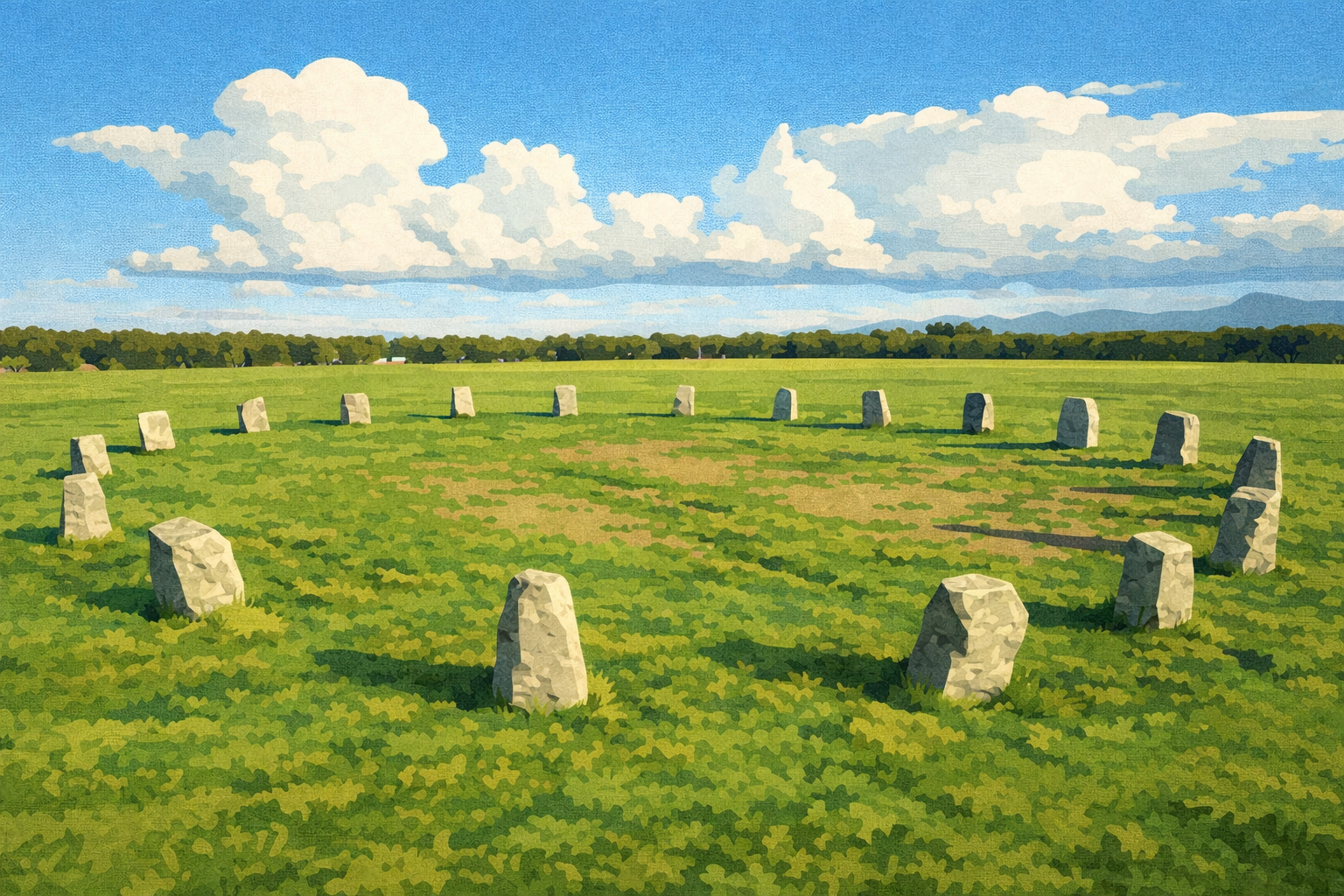








The Merry Maidens stone circle consists of 19 granite megaliths positioned in a nearly circular pattern within a field located between the villages of Lamorna and St Buryan in West Cornwall. These stones stand about 1.2 meters tall on average, with the tallest reaching roughly 1.4 meters, and are spaced three to four meters apart to form a circle approximately 24 meters in diameter. The surrounding landscape typifies the rural moorland of West Penwith, featuring open fields and distant views over Cornwall’s agricultural areas. Approximately 300 meters to the northeast lie The Pipers, two large standing stones measuring about 3 meters in height, with one rising as high as 4.6 meters and the other 4.1 meters. These are considered Cornwall’s largest surviving standing stones and are both geographically and mythologically connected to the Merry Maidens. Nearby, the Tregiffian burial chamber, dating to the early Bronze Age, adds to the area's rich prehistoric significance.
Archaeological and Historical Findings
Dating from the Late Neolithic to early Bronze Age, around 2500 to 1500 BCE, the Merry Maidens circle is made of locally sourced granite stones that were skillfully shaped and placed with impressive precision. Each stone's top was leveled, and its flattest face turned inward toward the circle’s center, showcasing sophisticated stoneworking and spatial planning by Neolithic builders. The stones decrease in size from the southwest to the northeast, a pattern believed to symbolize a lunar cycle. The site was first studied in detail by antiquarian William Borlase in 1769, who also recorded a second stone circle nearby; however, that second circle had mostly disappeared by the 19th century. More recent archaeological studies, including those by John Barnatt in 1982, suggest the original circle might have once contained 18 stones rather than the present 19. Restoration work carried out during the Victorian period (completed by 1879) involved repositioning some stones and adding others, not always replicating their original locations. As with many stone circles across Britain and Ireland, this site likely held an important function in ceremonial and ritual activities for the prehistoric communities who built it.
Archaeoastronomic Orientation
The orderly arrangement of the Merry Maidens stones, especially the gradual decrease in stone size from southwest to northeast, points to intentional design possibly linked to observing celestial events. The builders’ precise leveling of the stones indicates advanced spatial awareness. While the circle may have had connections to astronomical practices or rituals, no definitive solar or lunar alignments have been confirmed, and further research is needed to clarify any specific archaeoastronomic significance.
Legends, Folklore, and Myths
Rich folklore surrounds the Merry Maidens, much of which likely originated in the medieval period. The most well-known tale tells of 19 maidens who were caught dancing on a Sunday and were turned into stone as a divine punishment for breaking the Sabbath. Another version elaborates on the story by including The Pipers; two standing stones nearby believed to represent the petrified musicians who played for the dancers. The name “Merry Maidens” is derived from Cornish roots, with the original term possibly meaning “dance of stones” or “sacred stones,” though these meanings have changed over time through the influence of language evolution.
Accessibility and Visitor Information
Located about 2 kilometers south of St Buryan village, the Merry Maidens stone circle lies in a field accessible from the B3315 road that runs between Newlyn and Land’s End. The site sits between Lamorna and St Buryan on Cornwall’s western tip. Visitors can park in a small lot at the bottom of the field and reach the circle by following a public footpath over a stile. The walk through open grassland is relatively short and takes place on generally level terrain characteristic of the Penwith moorland. While the main route is accessible, those requiring disabled access may need assistance to open a gate at the field's upper boundary. Entry to the site is free during daylight hours and does not require a guide. Visitors are encouraged to respect the farming environment by staying on marked paths and avoiding any damage to the landscape. No special clothing or equipment is necessary for visiting.