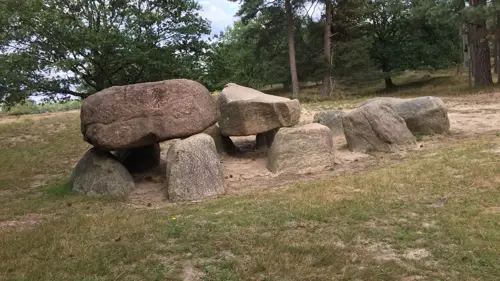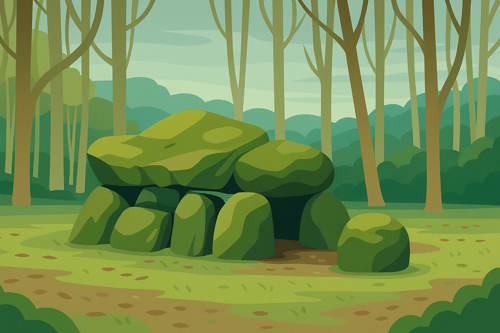













Hunebed D1 exemplifies a ‘hunebed,’ a Dutch term for prehistoric stone chamber tombs, commonly known as dolmens. Positioned on open ground bordering the forest, the monument consists of several upright stones supporting massive capstones, forming a long chamber. Unlike some other hunebeds, D1 lacks the surrounding kerbstones typically found encircling these tombs, yet its main structure remains largely intact, showcasing the enduring skill of its builders. This site ranks among the northernmost hunebeds in the Netherlands, a region, especially the province of Drenthe, celebrated for its concentration of Stone Age burial monuments.
Archaeological and Historical Findings
Research spanning many years, including work by early archaeologists such as A.E. van Giffen, indicates that Hunebed D1 was constructed during the Neolithic period by the Funnel Beaker culture, approximately between 3400 and 2850 BCE. The monument is composed of large glacial erratics, boulders deposited in the area during ancient ice ages, that were carefully arranged to form a burial chamber. Hunebed D1 is one of 54 remaining hunebeds in the Netherlands, almost all of which are located within Drenthe. Archaeological investigation suggests these sites functioned as communal burial places. Artifacts like pottery and flint tools have been uncovered at some dolmens, though Hunebed D1 itself has not undergone a thorough modern excavation.
Accessibility and Visitor Information
Hunebed D1 can be reached by a short, easy path approximately 100 meters long, leading from the nearest road or informal entrance. The terrain is flat and accessible, making the approach suitable for most visitors, including those with limited mobility. There are no significant inclines, steps, or uneven sections along the way. Entrance to Hunebed D1 is free of charge.