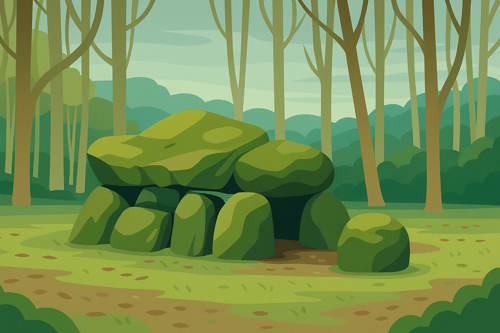













Hunebed D5 is a modest yet meaningful prehistoric dolmen located approximately 100 meters from the Zeijen-Peest road. Unlike some larger and more prominent hunebeds, this one lies in a shallow depression, with only its four capstones clearly visible from afar. Beneath these capstones, ten side- and endstones provide structural support, many partially covered by sand. The dolmen is set within a tranquil park area surrounded by Drenthe’s characteristic meadows, encouraging visitors to pause and appreciate the site. Nearby, the Zeijer Strubben nature reserve offers further opportunities for exploration. D5 is smaller than other dolmens in the area, such as D3 and D4, which visitors can also explore in the broader region.
Archaeological and Historical Findings
Hunebed D5 dates back to the Neolithic era and was constructed by the Funnelbeaker culture roughly between 3350 and 3050 BCE. The builders used large glacial boulders placed during the last Ice Age, arranging them to create a communal burial chamber. The dolmen consists of ten supporting stones holding up four remaining capstones. Originally, the structure was covered by a sand mound which helped protect it over time; this earthen covering remained until its partial excavation in the 19th century. The chamber was left partly buried, which has contributed to the good preservation of this smaller hunebed. The base outline of the original burial mound is still visible, providing a physical connection to prehistoric construction and burial practices.
Accessibility and Visitor Information
Visitors can access Hunebed D5 via a paved path less than 100 meters from the closest parking area. The terrain is flat and accessible, suitable for the majority of visitors, including those with limited mobility. The dolmen stands within a grassy section of a small park that features benches for rest and enjoyment of the natural surroundings. The site is easy to reach, with no significant slopes, steps, or barriers. The site is free to visit.