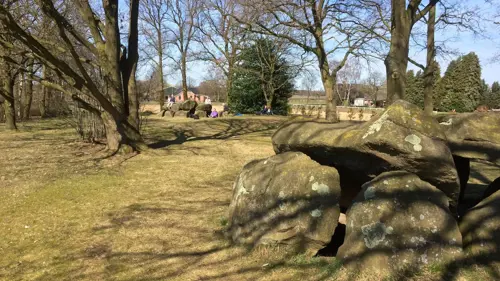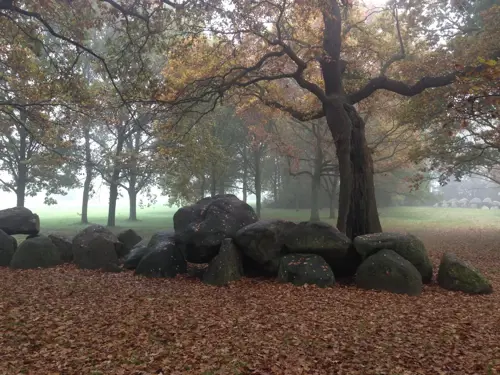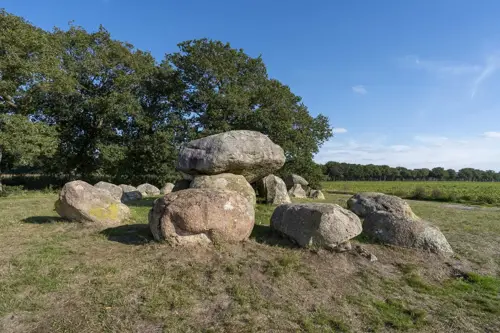













Located in a calm part of Drenthe, Hunebed D30 consists of large boulders arranged among woodland and heathland, a landscape typical to the area. The dolmen features massive capstones supported by upright stones, forming a characteristic elongated chamber. While there are several hunebeds in this province, each has its own unique character. D30 provides a serene setting with fewer visitors, making it an excellent spot for contemplation and discovery. The surrounding natural environment also offers trails for walking and cycling, allowing visitors to experience both historical heritage and nature.
Archaeological and Historical Findings
Research identifies Hunebed D30 as a chambered tomb created by the Funnel Beaker Culture between roughly 3400 and 2850 BCE. Its structure includes upright stones supporting heavy capstones and was originally covered by an earthen mound, though much of this covering has since disappeared. The stones themselves are glacial erratics, transported to the area by retreating ice sheets after the last Ice Age. Excavations of similar nearby hunebeds have revealed grave goods, pottery, and artifacts that shed light on burial traditions, social structures, and craftsmanship during the Neolithic. Despite some restoration work over time, D30 maintains the typical layout of passage graves found throughout Drenthe.
Accessibility and Visitor Information
Hunebed D30 is located in the Boswachterij Exloo forest area, approximately 1 kilometer northwest of Exloo village in Drenthe. There is an off-road parking area at the Boslaan next to the D30 monument. From there, it's a 100 meter walk to the monument. The terrain is flat but can be uneven, so sturdy footwear is recommended. Entry to the site is free year-round.