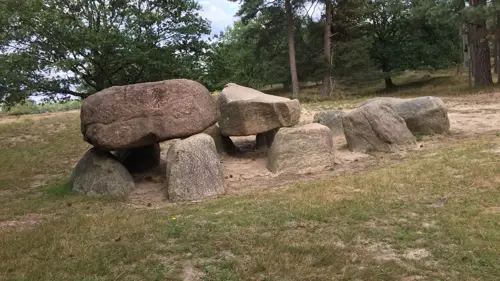













Positioned just outside Westervelde in Drenthe, the monument is set within a gently rolling rural landscape characteristic of this northern Dutch region. Hunebed D2 consists of large upright stones known as orthostats, supporting horizontal capstones to create a chamber once used as a burial site during the Neolithic era. This site is one of over fifty hunebedden in Drenthe, notable for its well-preserved condition and serene surroundings. While the area contains many similar structures varying in size and design, D2 provides a distinctive glimpse into ancient times, serving as a rewarding complement or alternative to the more frequently visited megalithic sites nearby.
Archaeological and Historical Findings
Studies indicate that Hunebed D2 was built by communities of the Funnel Beaker Culture between roughly 3400 and 3000 BCE, ranking it among the oldest surviving monuments in the Netherlands. The builders utilized large granite boulders, glacial deposits from the Ice Age, to assemble communal tombs for families or clans. The stones were likely gathered from local fields, and construction relied on tools made from antler and wood, reflecting the ingenious techniques of the time in moving and positioning massive rocks without metal tools. Although no extensive modern excavations have been carried out at D2 itself, comparable hunebedden have revealed artifacts including distinctive pottery, flint implements, and personal decorations. The structure’s remaining elements, a chamber with upright stones and two large capstones (originally likely four, with two intact and one fragment remaining inside), illustrate advanced Neolithic engineering aimed at durability and monumentality.
Accessibility and Visitor Information
Hunebed D2 can be reached via a small parking spot adjacent to the Melkweg road in Westervelde. From there, visitors follow a flat, unpaved trail about 120 meters in length through open fields. The path is mostly accessible for a wide range of visitors, though some uneven ground may pose challenges for those with limited mobility, especially during wet conditions. There are no stairs or steep inclines, making for a pleasant, easy walk. Entrance to the site is free, and it is open throughout the year.