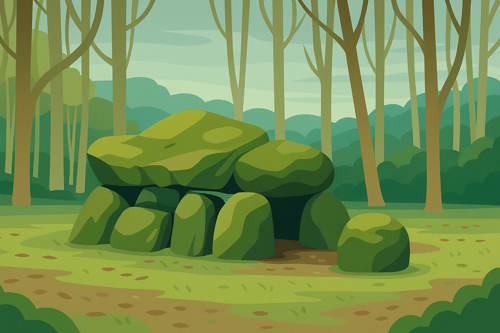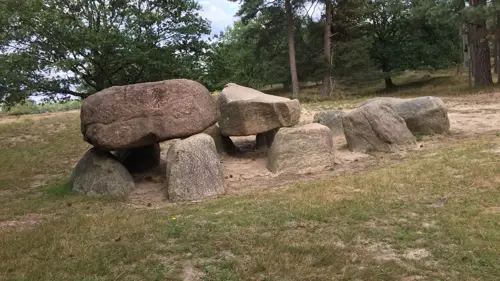












Hunebed D7 is a small but well-preserved megalithic burial site located in a forested area close to the village of Schipborg, in the province of Drenthe. Compared to some of the larger and more frequently visited hunebeds, such as the famed site at Borger, D7’s quiet and intimate setting distinguishes it. The structure consists of large granite boulders arranged to form a chamber, topped by several capstones resting on upright stones. Visitors often seek out this less crowded site for a more personal experience of prehistoric heritage. Hunebed D7 is part of a rich regional landscape marked by similar ancient tombs, all connected to the Funnel Beaker Culture’s legacy.
Archaeological and Historical Findings
Research and archaeological findings date Hunebed D7 to the Neolithic period, approximately between 3400 and 3000 BCE. Like other hunebeds, it was constructed by the Funnel Beaker people, who were among the first farming communities in what is now the Netherlands. The tomb comprises large glacial erratics that were moved and positioned by human effort without metal tools or the wheel. Initially, the stone chamber would have been covered by an earthen mound, with only the capstones visible above ground. Excavations at related sites have shown these tombs functioned as communal burial places, where the deceased were interred together with objects such as pottery, flint tools, and beads, reflecting the social and ritual customs of that era.
Accessibility and Visitor Information
Hunebed D7 is accessible via a woodland trail starting from the designated parking area near Schipborg. The walk to the site covers roughly 400 meters on a flat, unpaved path that is generally well-maintained. The path meanders through a small forest and may be uneven in spots but does not involve steep slopes or stairs. The site is open year-round, though visitors should take care during wet weather as the ground can become soft and slippery. Visiting Hunebed D7 is free of charge and open throughout the year.